

Topeka and Shawnee County: Latest Updates
Updated On September 10, 2026
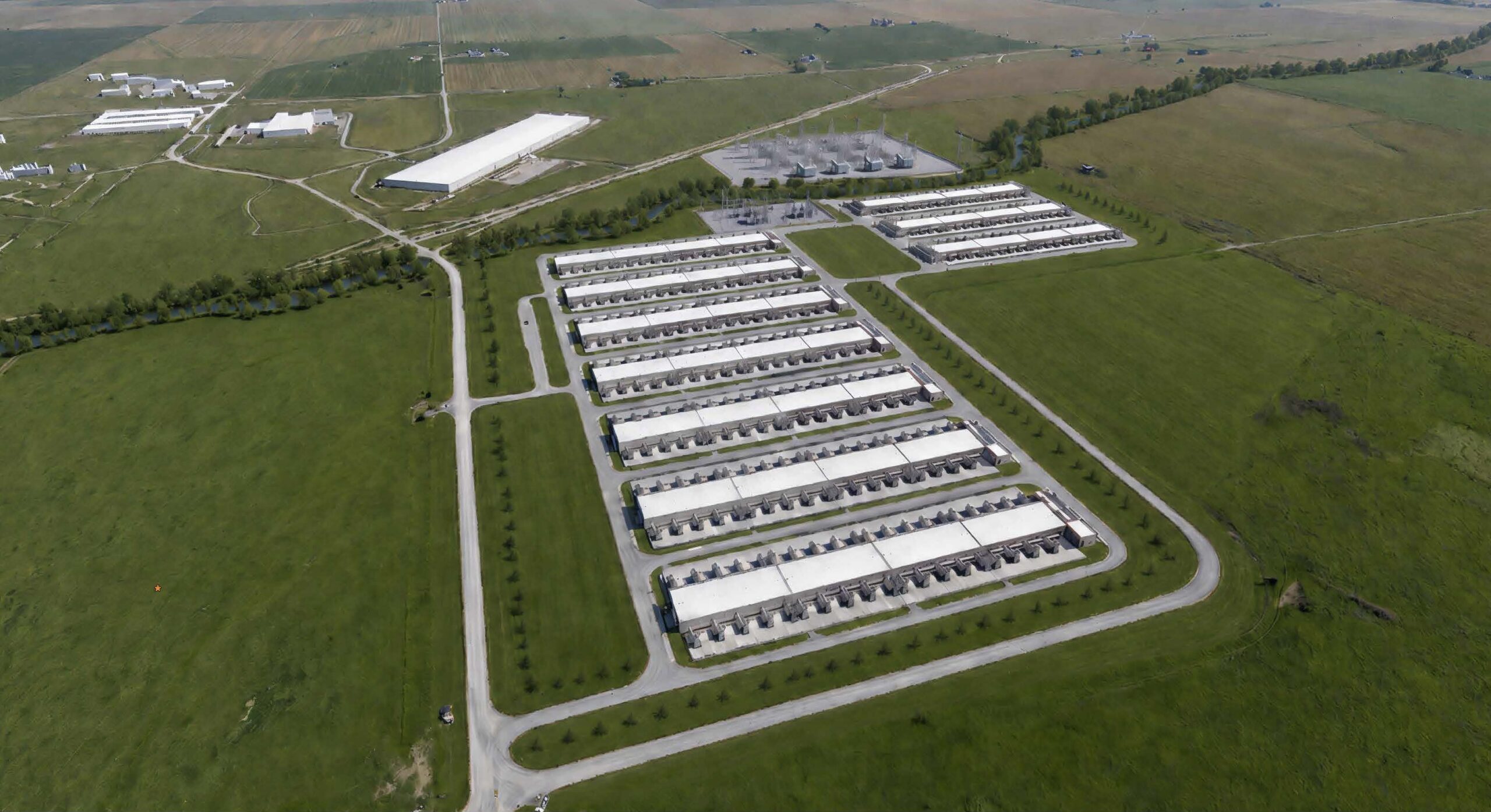

Proposed Shawnee County Campus: Project Overview
Learn more about Compass Datacenters, our proposed campus in Shawnee County and how we plan to be a long-term community partner.
Campus Information
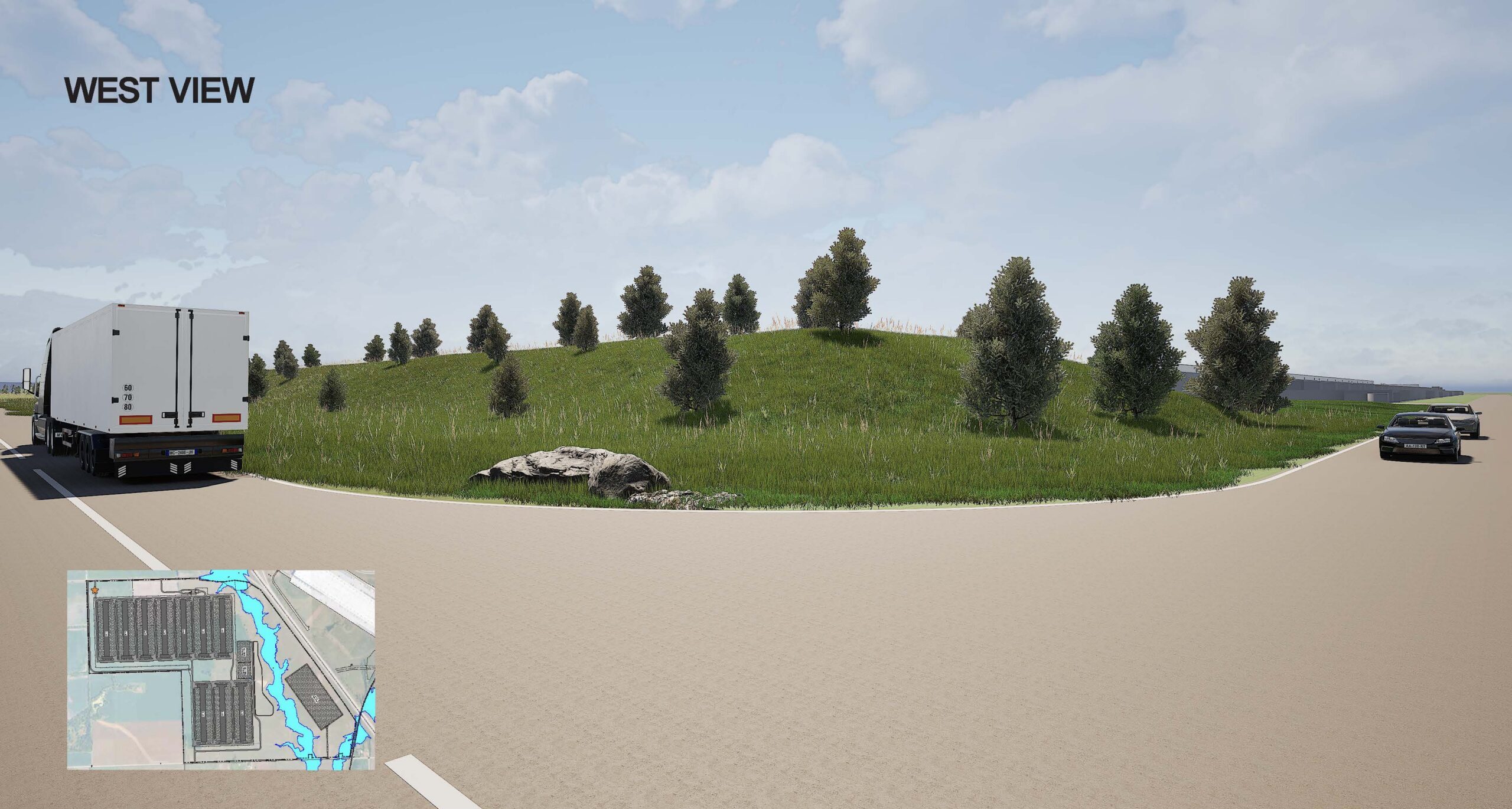
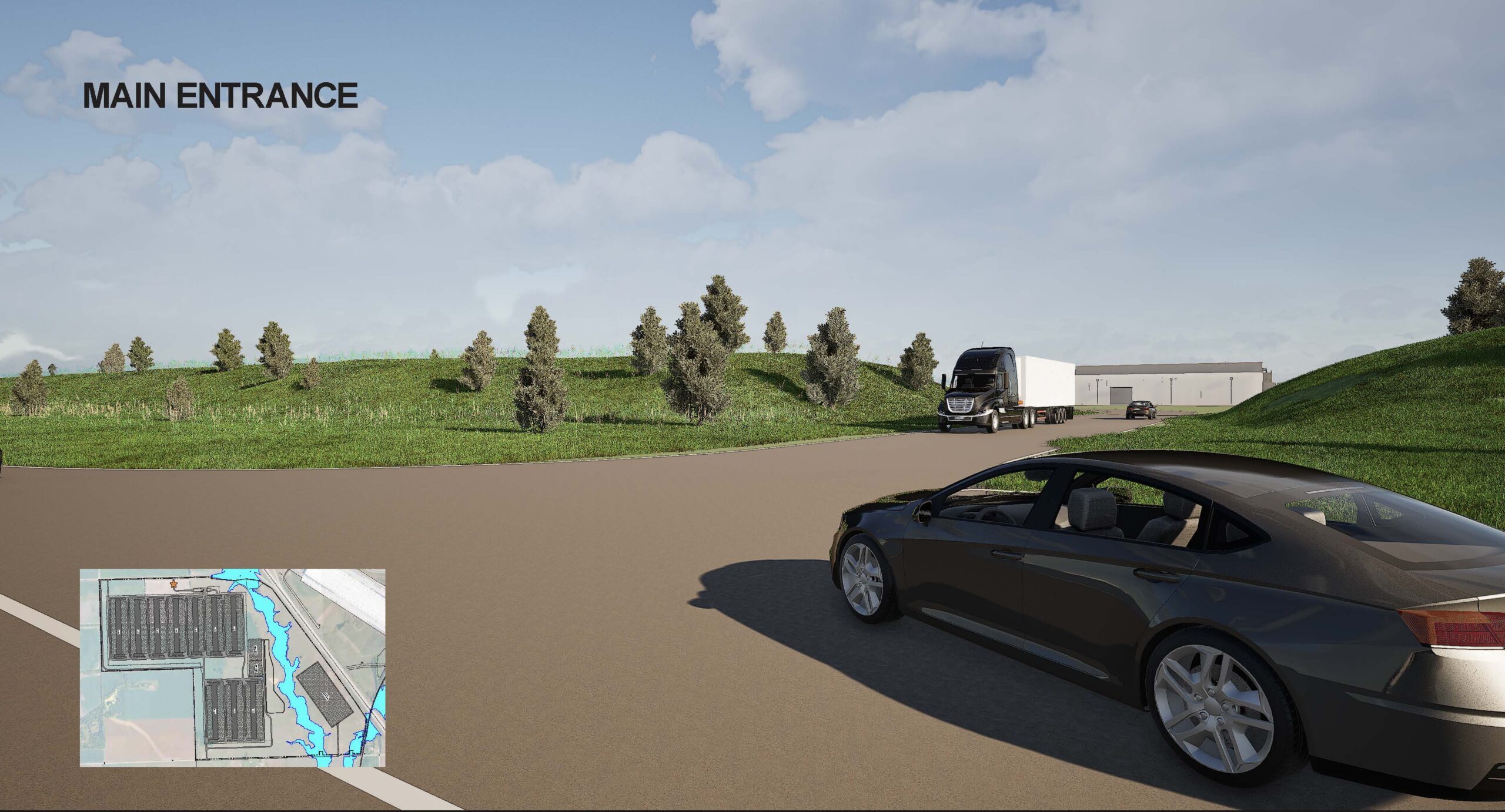

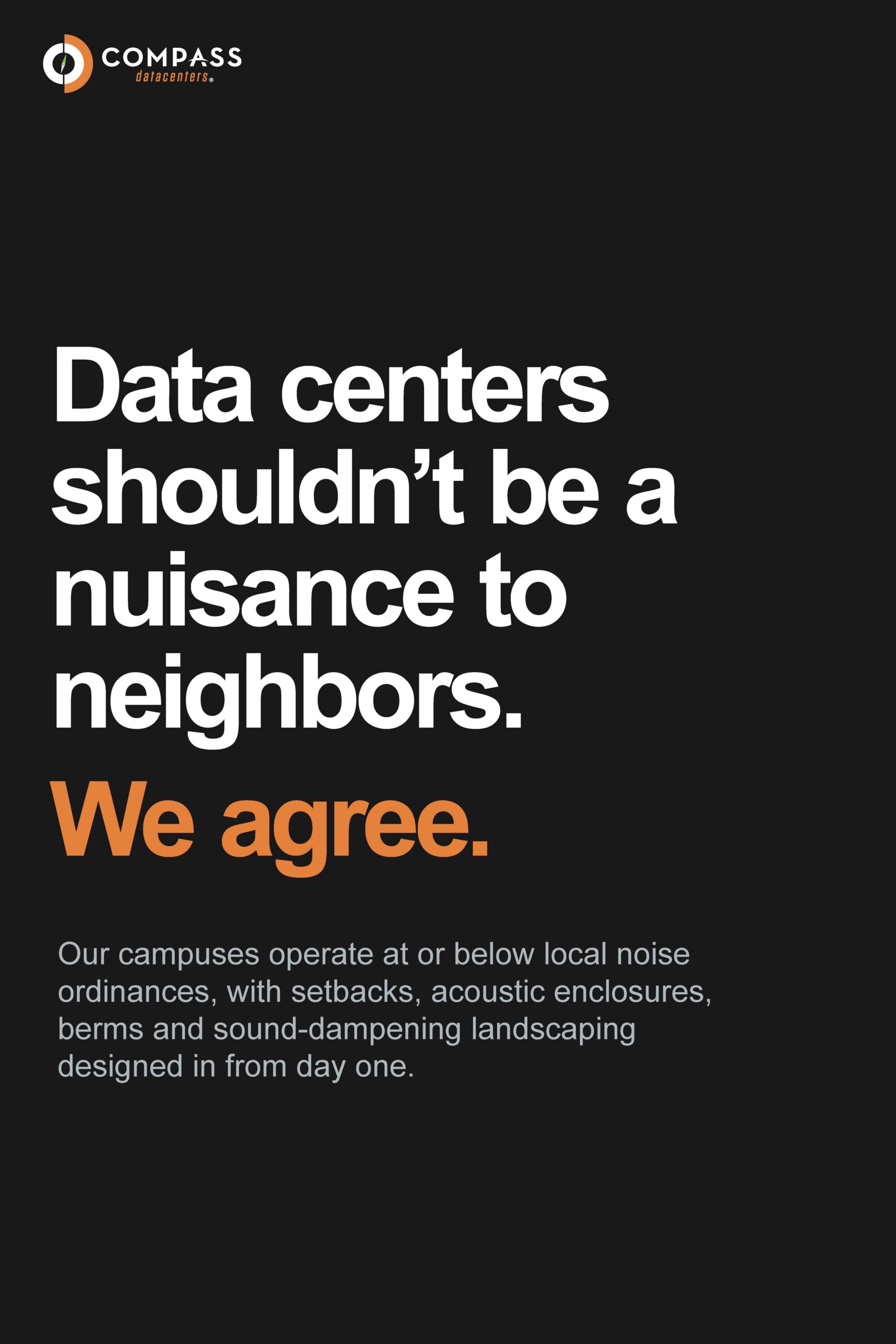

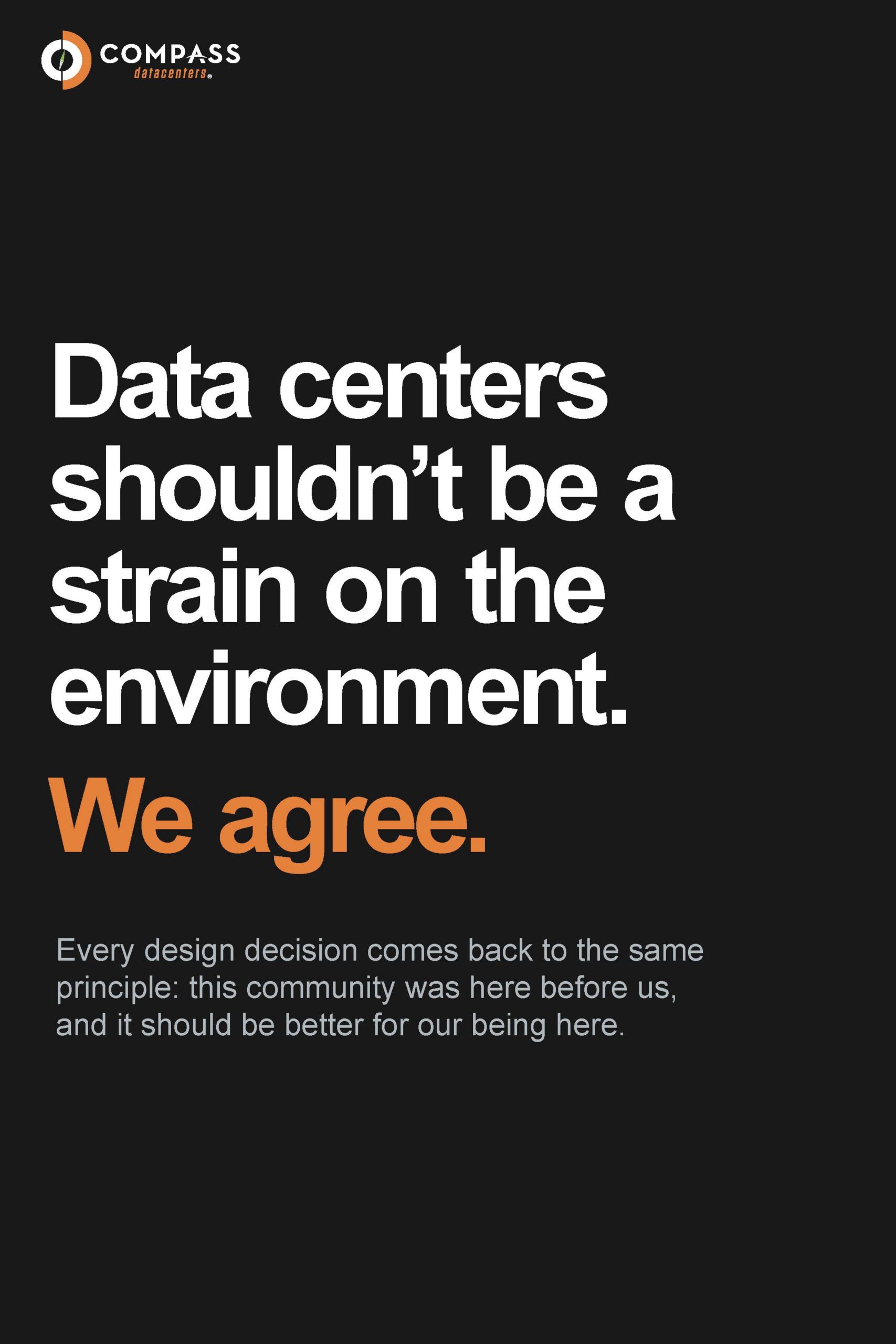
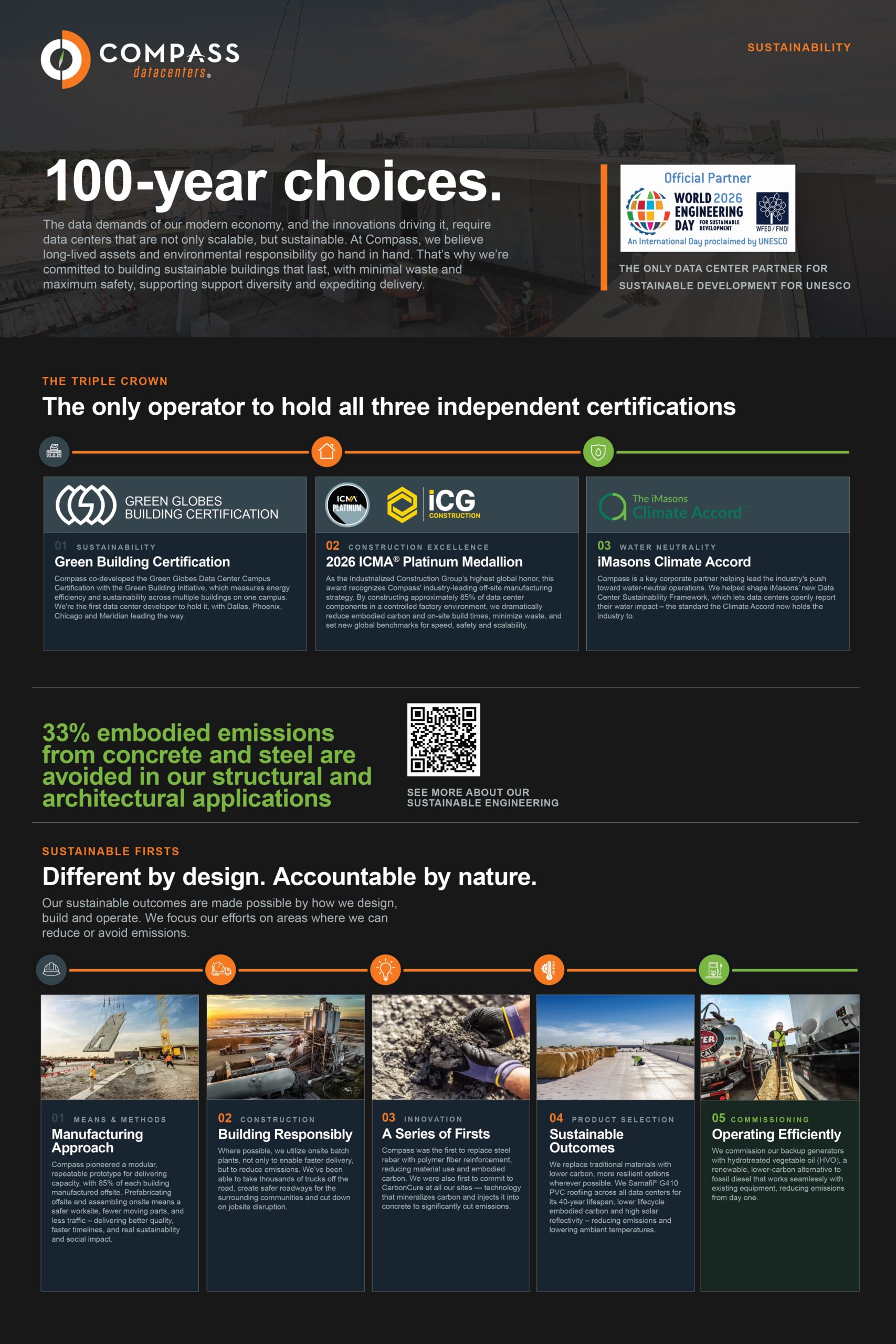
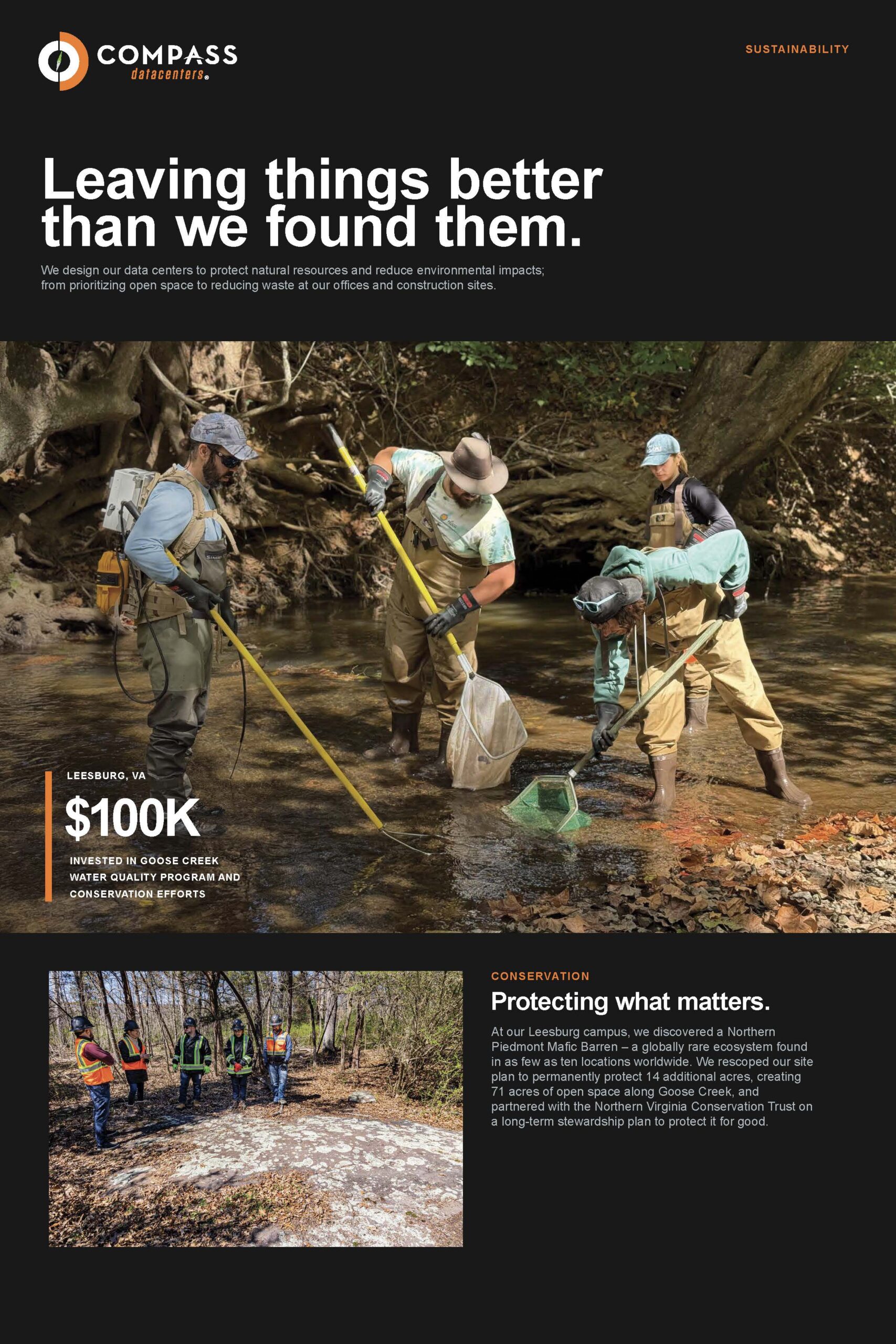

Reporting and independent analysis on the questions we hear most from communities.
Frequently Asked Questions
At our July open house, residents asked us to put our answers in writing. These are answers to some of the questions we’ve received most frequently.
About Compass
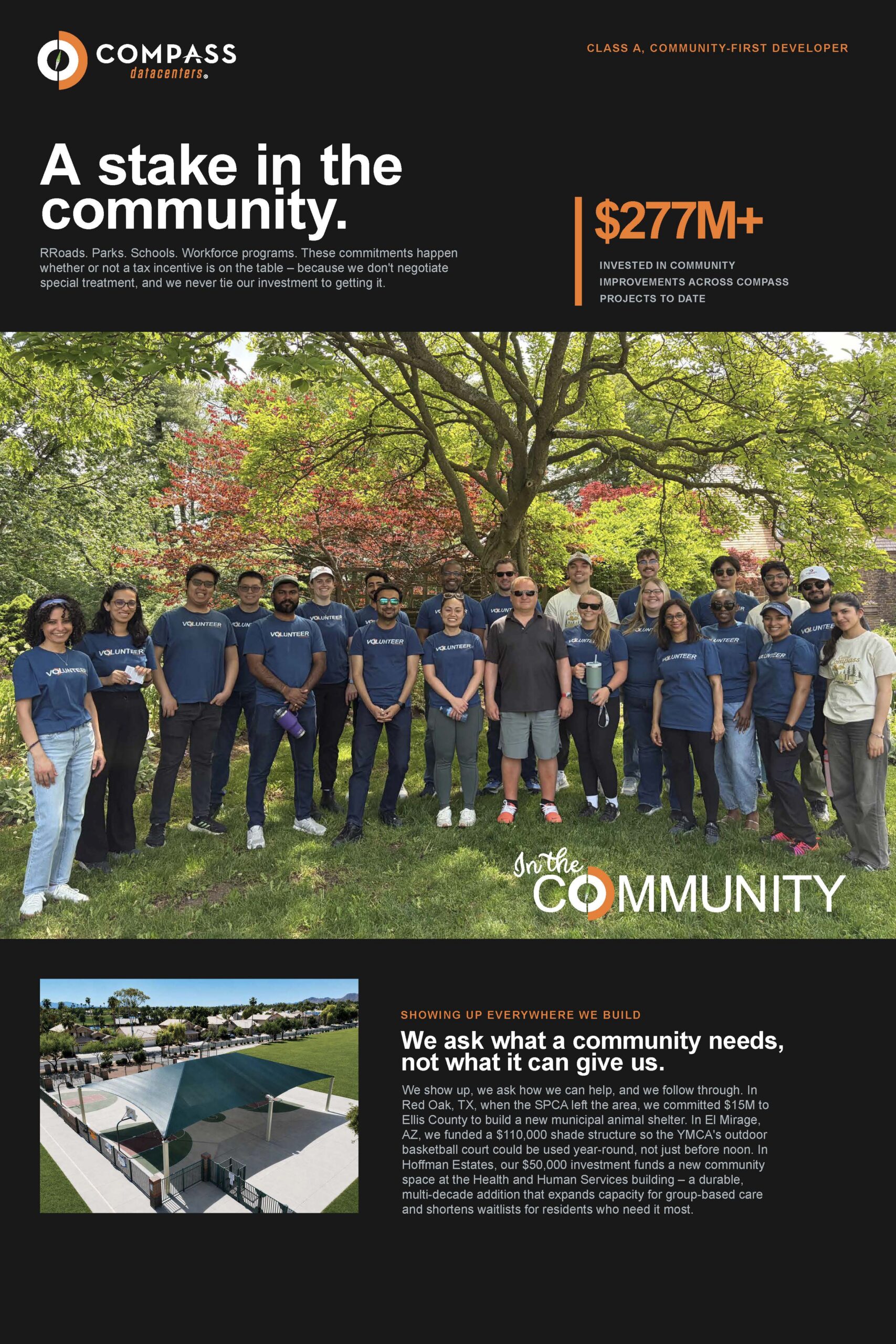
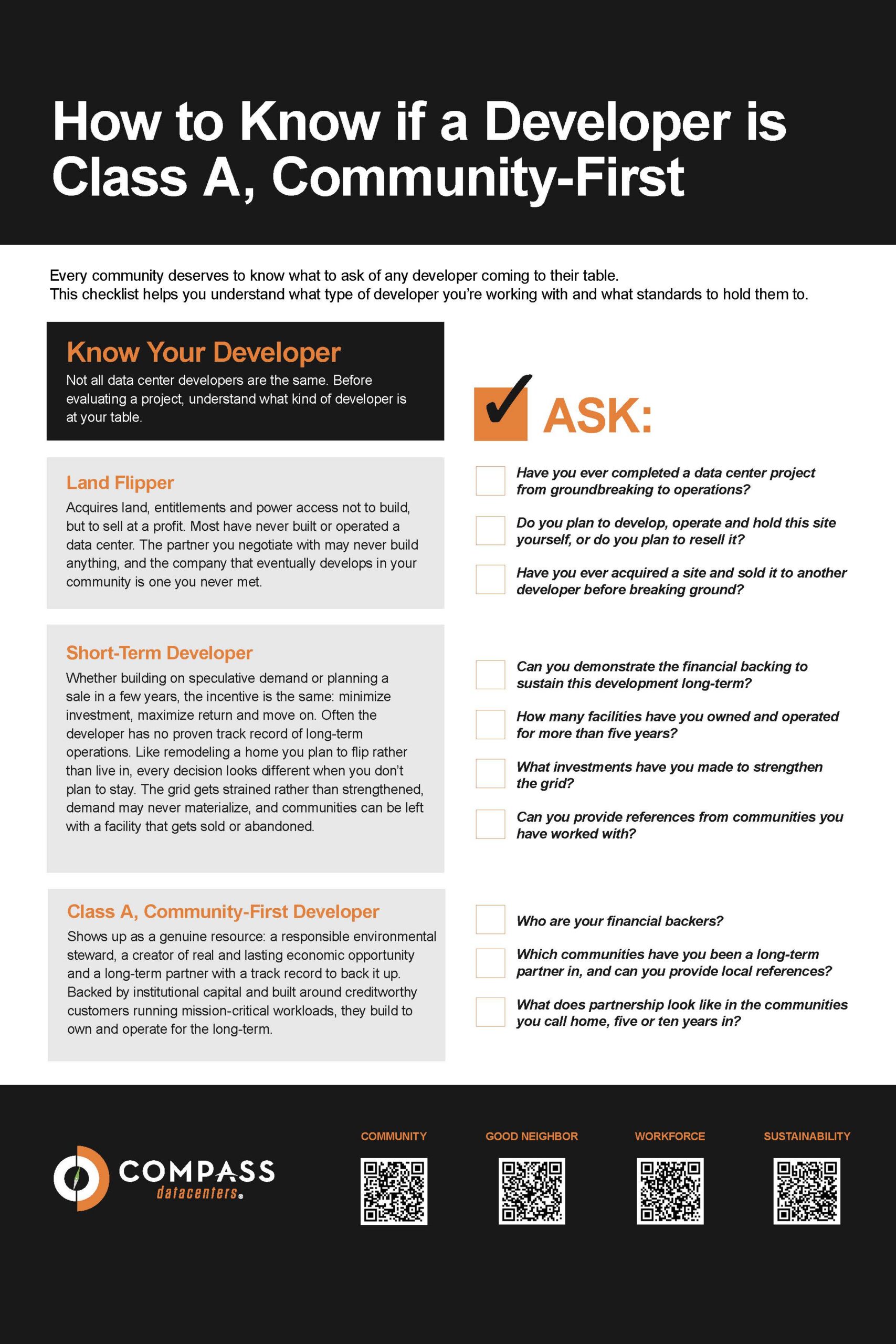
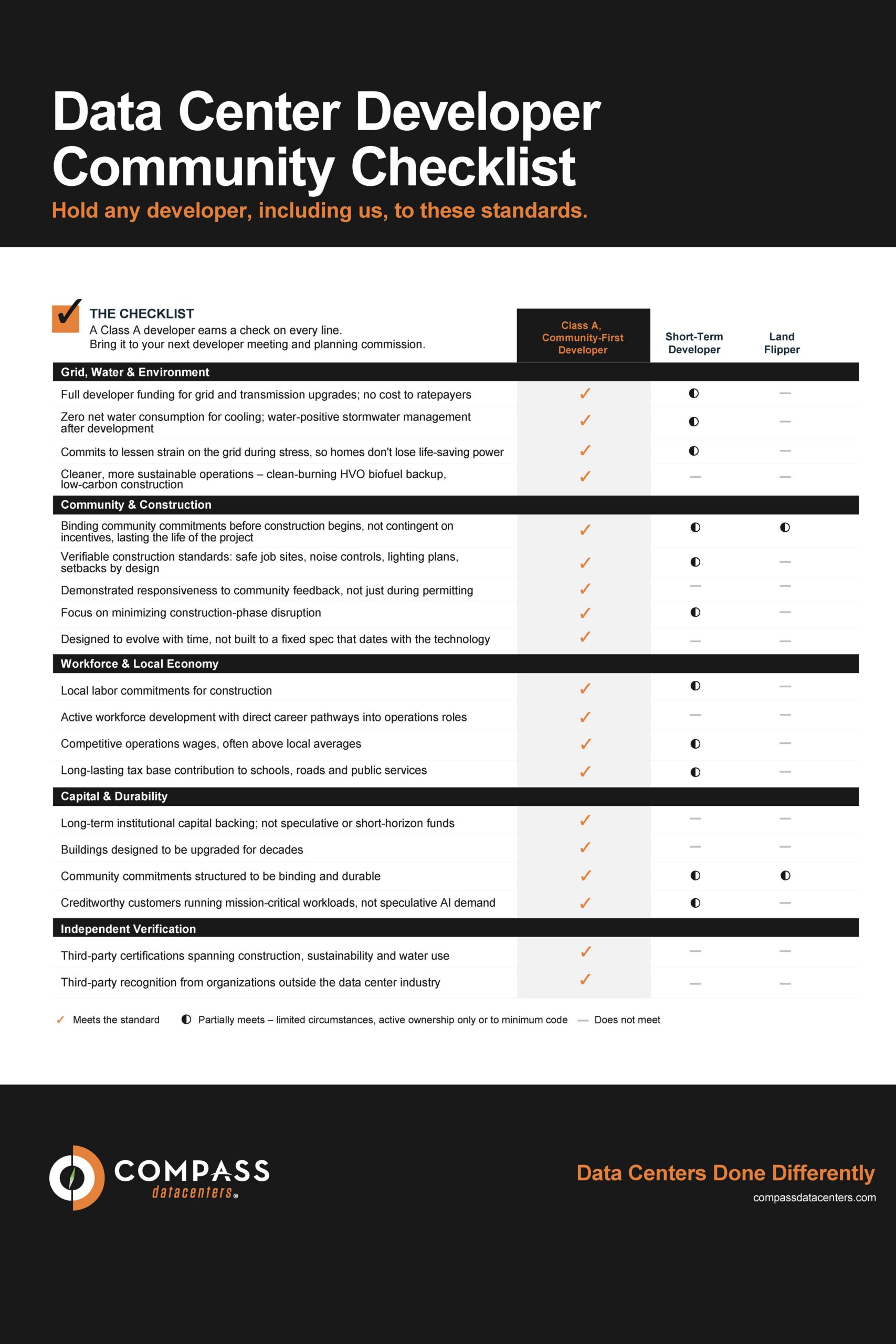
Who we are: Compass Datacenters does data centers differently. As a Class A, Community-First developer, we hold every project to the highest standards – shaped by more than 15 years of experience, 20 campuses and close partnerships where we build. That commitment is backed by real financial strength and respected world-class customers who are in this for the long term. We build, own and operate every campus as a 100-year asset, so we have a real stake in its ongoing success.
Who is your customer, and what will go into the building?
Our customers are cloud and hyperscale providers — companies whose names people would recognize. The building holds servers and other equipment that support business critical computing that people use every day. Things like online banking and electronic payments, hospital and medical records, insurance claims, shipping and logistics and email, photo sharing and streaming.
If you build it, will you stay?
That is the right question to ask any developer. We own and operate every campus we build rather than selling them. The buildings are designed so equipment can be replaced as technology changes, without rebuilding. We have the same interest Topeka does in this region’s grid, roads and water still being sound decades from now.
About This Project
Why Topeka and Shawnee County, rather than a rural county with far fewer people?
Topeka has ample long-haul fiber along I-70. The site sits near an existing Evergy substation, and high-voltage transmission lines already run through the property. Those things make the site ideal for Compass.
The site has been zoned for light industrial development since 2012, and it is located inside the South Topeka Economic Growth Corridor, which is already home to the Walmart Distribution Center and the Mars plant.
Most importantly, we need workers for this project, and we want to invest in the community as a neighbor with people who live and work in the Topeka area.
Do you have a signed customer for this campus, or is it being built on speculation?
We work with the five largest global cloud and hyperscale providers. They are names you know. While we do not have a customer identified for this site, our building design allows any of our customers to utilize it to support the business-critical services people use every day, including electronic payments and banking, digital health records, shipping and logistics, email, photo sharing and streaming services.
How many buildings would the project include, and over what period?
The CUP application shows the campus would include up to ten buildings, built in phases. The pace of completion depends on many variables, including when Evergy can make capacity available. Based on current assumptions, construction would run from 2028 through 2031, with full operations beginning in 2031.
Each building would become taxable as soon as the certificate of occupancy is received from the city so that the client can move in. Compass is the fastest builder in the industry with the ability to deliver a building within 12 months of lease signing.
What makes up the $4.5 billion investment?
The $4.5 billion is the total investment for a ten-building campus, roughly $450 million per building.
On the tax side, Kansas appraises and taxes commercial real property at 25% of its market value. For a campus like this, the taxable real property includes:
- Land, meaning the total acreage and site parcels
- Buildings, meaning the walls, roofing, foundation and structural framing
- Site improvements such as paved parking, security fencing and permanent outdoor lighting
- Mechanical and electrical systems, including the large HVAC units, cooling equipment, on-site electrical substations and permanent backup generators.
* Kansas decides case by case whether equipment that is affixed to real estate, like HVAC units, cooling systems and backup generators, counts as part of the building or as separate business property. Compass will work directly with the local tax appraiser to appropriately classify these items for the tax records. The servers inside the buildings are a separate matter: those belong to our customer, not to Compass.
The Moratorium and The Process
What is your position on the moratorium?
This is a community that cares deeply about its future. We do too. Taking the time to consider whether our project is right for Topeka matters. We hope the answers we give the community will help with that.
Your application was ruled incomplete. Why should we trust anything you have told us?
Our supplemental response to Shawnee County was filed August 28 and the county confirmed our submission was considered complete on September 1, 2026. All of it is on file and public.
What the Community Will Receive
How many of the construction jobs will go to local workers?
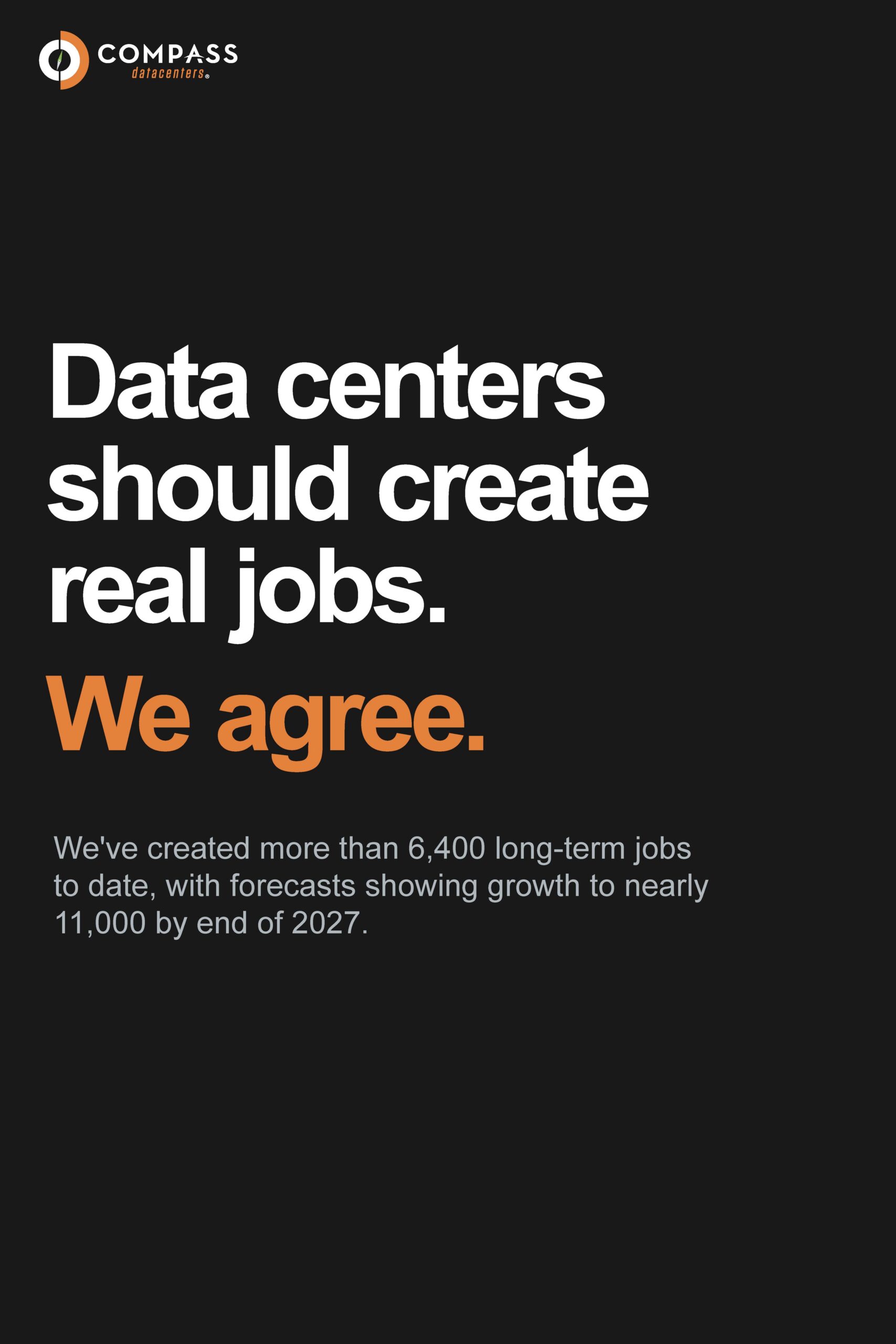
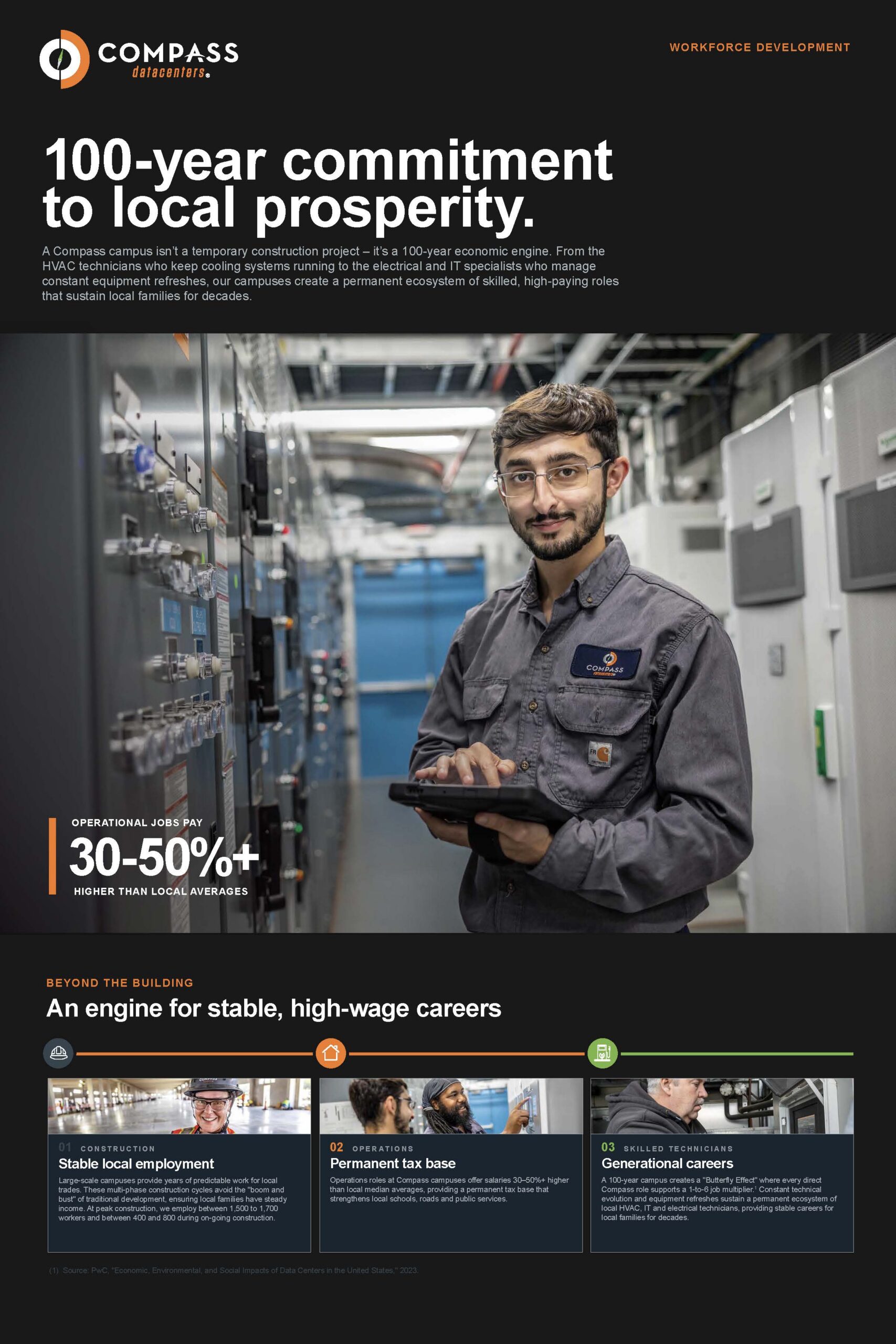
We estimate the project will support about 1,500 local jobs a year during construction based on a four-year build. Once the campus is operating, it will support approximately 700 permanent jobs across the metro Topeka area, about 300 of them on site. That is about thirty people per building, or 300 people for a ten-building campus. The remainder are in the businesses and services that support the campus such as accounting, engineering and legal.
Here is a current breakout from across five campuses, all at varying scope and stages of completion as of August, 2026:
| Project | Workers | Within 55 miles | In state |
| Metropolitan Markets Summary | 2,105 | 1,813 (86%) | 1,988 (94%) |
| Dallas-Fort Worth (Red Oak, Texas) |
663 | 442 (67%) | 620 (94%) |
| Phoenix (Goodyear, Arizona) | 104 | 100 (96%) | 102 (98%) |
| Phoenix (El Mirage, Arizona) | 518 | 481 (93%) | 483 (93%) |
| Chicago (Hoffman Estates, Illinois) | 820 | 790 (96%) | 783 (95%) |
| Micropolitan Market Summary | 1,173 | 404 (34%) | 888 (76%) |
| Meridian, Mississippi | 1,173 | 404 (34%) | 888 (76%) |
| All five projects | 3,278 | 2,217 (68%) | 2,876 (88%) |
|
Notes
In our large metropolitan markets, 86% of the trades workforce lives within 55 miles of the job, ranging from 67% at Dallas-Fort Worth to 96% at Chicago, and 94% live in state.
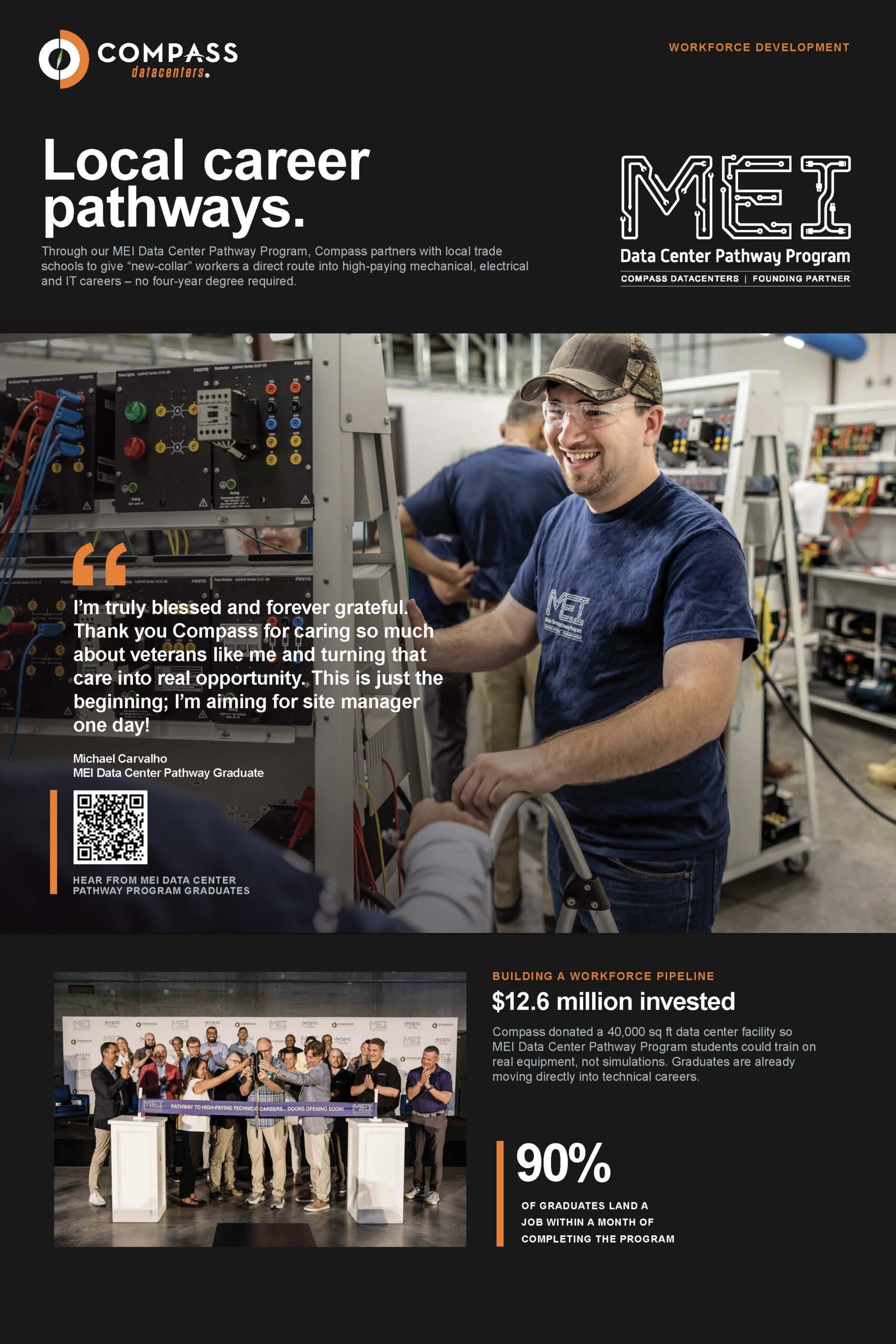
Meridian’s three-county area has fewer than 100,000 residents, and that project alone requires 1,173 trades workers. Roughly one in three lives within 55 miles, and 76% are Mississippians. We recently established the MEI Data Center Pathway Program with Meridian Community College to build the local pipeline of skilled technicians.
In Topeka, we are committed to local-first sourcing and building a skilled-trades pipeline with Washburn Tech through our MEI Pathway Program and quarterly public reporting of where our workforce lives, measured by home ZIP code. |
|||
Water
Will you capture and reuse rainwater from the roofs?
We are open to working on this with city planners to determine the best answer for the community.
Our current building design does not use captured rainwater. In many communities, stormwater run-off is counted as part of the municipal water supply. If we captured and held the rain falling on our roofs, we would be keeping that water out of the system.
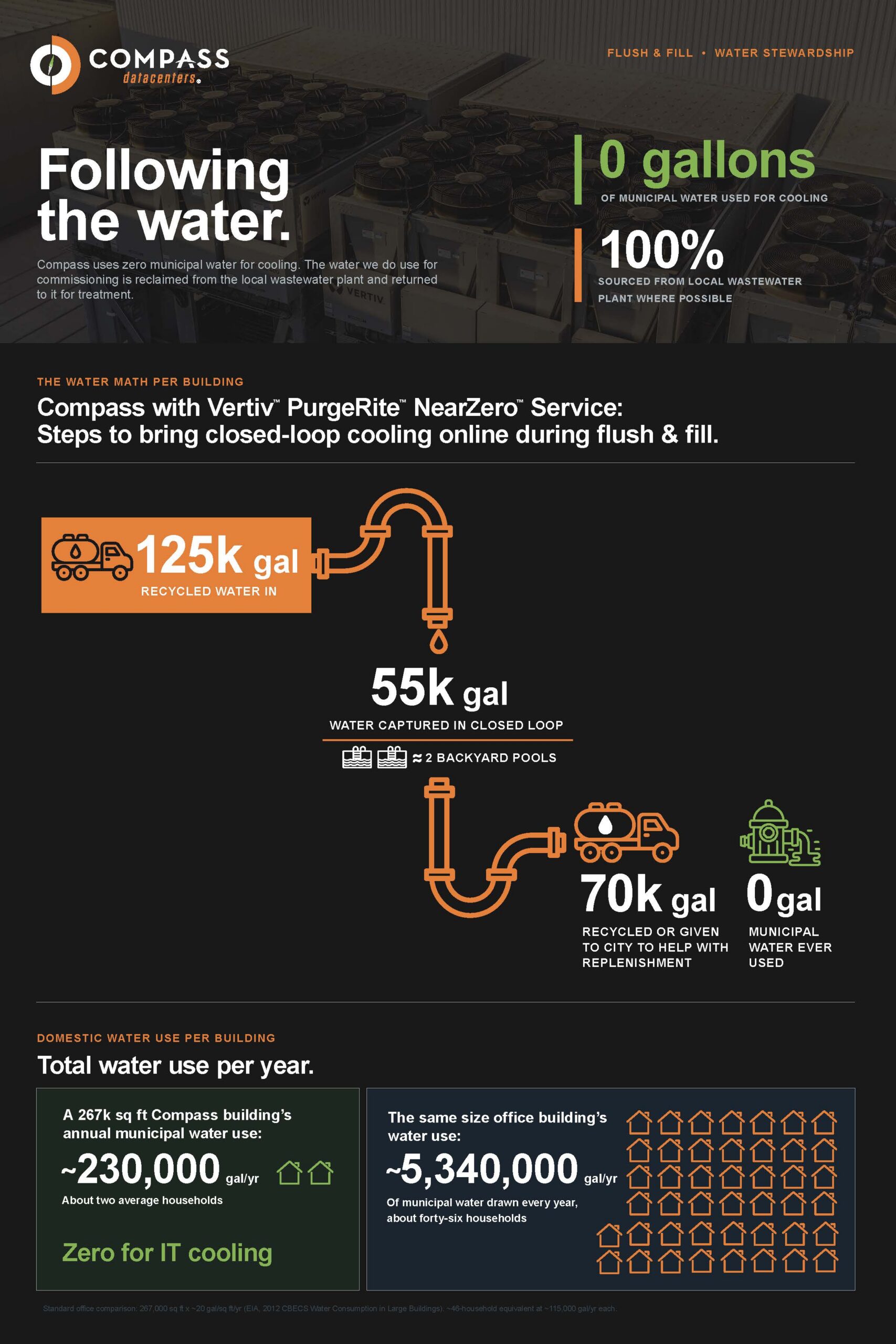
Each building on our campus uses less water than two households annually, so retaining our rainwater would almost certainly hold back more water from the community than the campus would ever draw from it.
We are open to working on this with city planners to determine the best answer for the community.
Is water trucked in and out, or not? The answers have sounded different at different meetings.
Both are true, and they describe different water.
Piped in (via municipal water connection): Water used for restrooms, break rooms, sinks plus humidification. This is the recurring draw, and per building, it totals about what two homes use in a year.
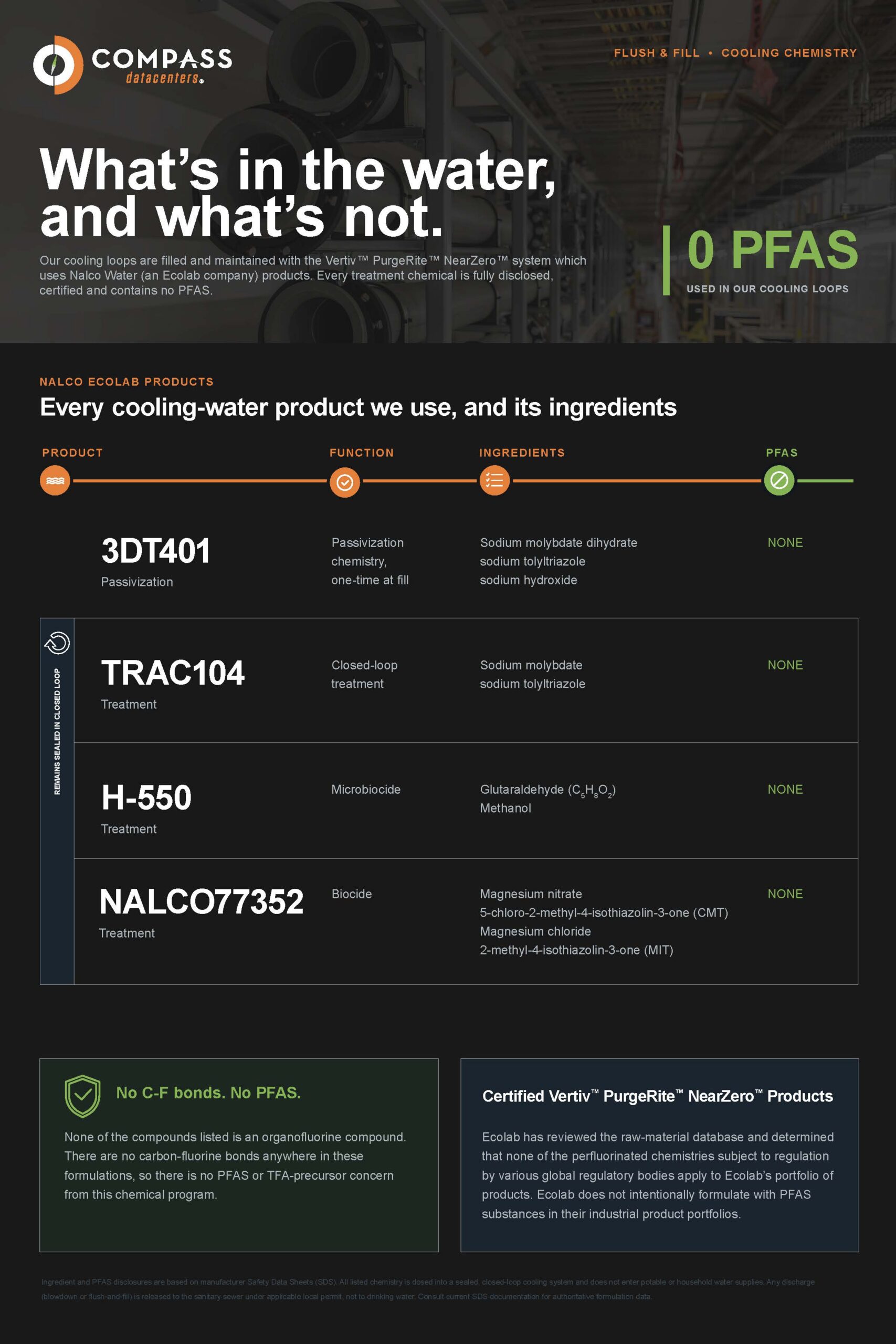
Trucked in, once: This is the water that flushes and fills the cooling loop. It’s non-potable water from a reclaimed, industrial supplier where available. Per building, about 125,000 gallons comes in for the flush and fill process, with about 55,000 gallons remaining in the loop. Once filled, the cooling loop stays filled and nothing is discharged to a drain or the storm system. If the fluid ever needs replacing, a licensed handler collects it for reclamation and reuse.
Trucked out: The remaining water (approximately 70,000 gallons) from commissioning is either delivered to the local wastewater facility, if they want it, or trucked out by a licensed industrial water handler.
What is added to the water, and what happens if there is a leak?
Standard biocides and anti-corrosion additives, the same ones used across industry rather than anything specific to data centers. Those are listed on our Topeka project page and were on display at the open house. None contain PFAS, or ‘forever chemicals.’
The loop is pressure-tested and flushed before it is filled, and the water is routinely tested by a third party to maintain the chemistry in the loop. This maintenance allows the water in the cooling loop to be recirculated indefinitely.
The loop is sealed and sits inside the building, and leak detection monitoring runs throughout the facility, so a change in pressure shows up straight away. Every data hall carries standard spill containment equipment in the same way it carries fire extinguishers.
Who tests the water, and who do they report to?
Nalco, an Ecolab company, under contract to Compass. Vertiv supplies our cooling equipment. Our customers also require ongoing periodic testing.
All environmental testing laboratories, including Nalco, must use standardized published methods that are set and overseen by public health and environmental agencies. Where a result triggers a reporting requirement, the report goes to the oversight agency directly.
The cooling loop never connects to the drinking water system. What leaves the site through the sewer is ordinary sanitary wastewater from restrooms and break rooms.
Power
| Will the data center raise my electricity bill?
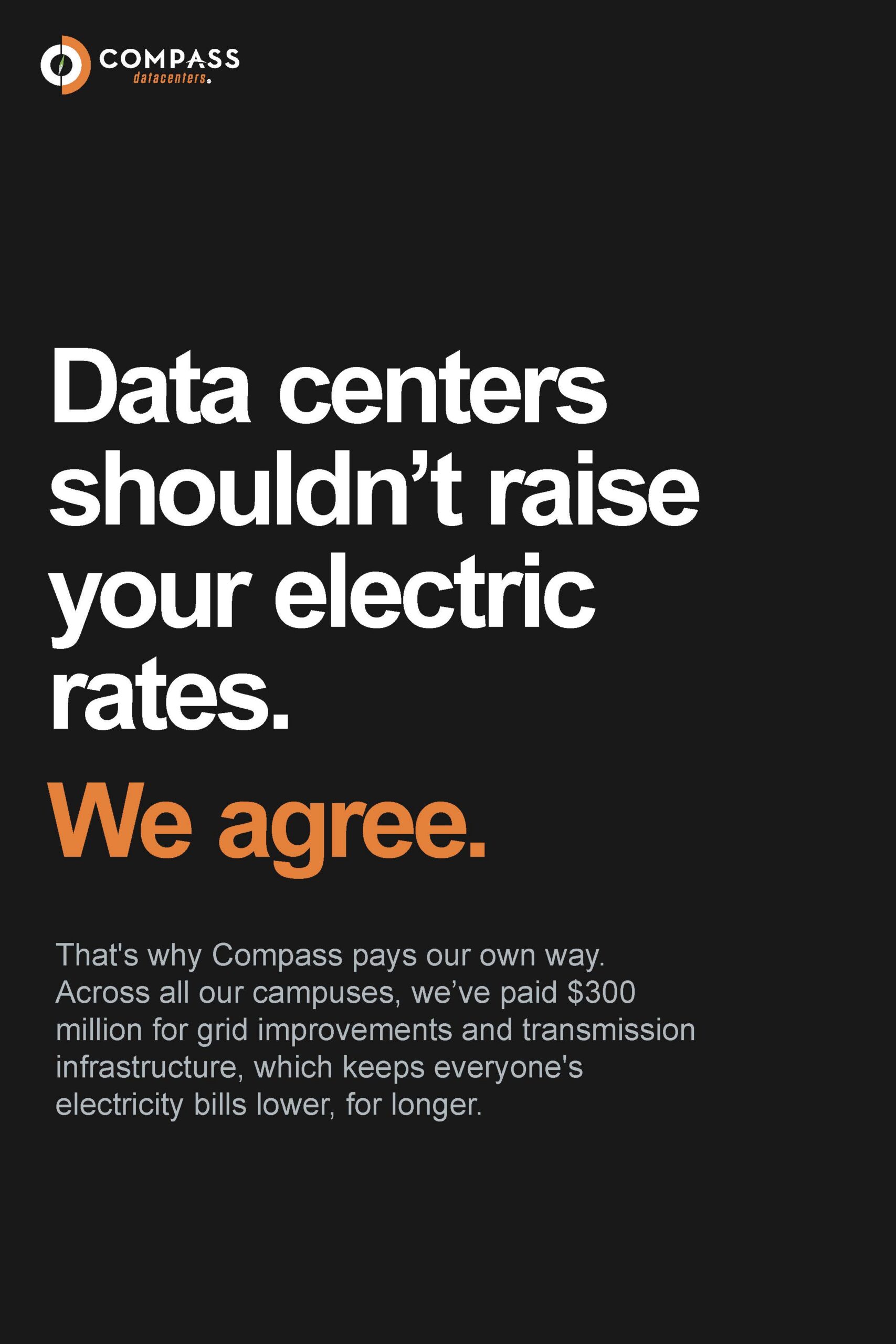
We pay for the infrastructure our campus needs, or pay a higher dedicated rate charged only to us. Either way those costs are not added to residential bills. Twenty-five utilities across nineteen states have adopted this approach. We cannot promise a utility will never raise rates — fuel prices, storms and unrelated capital projects all drive rates. What we can say is that our load will not be the reason. |
|
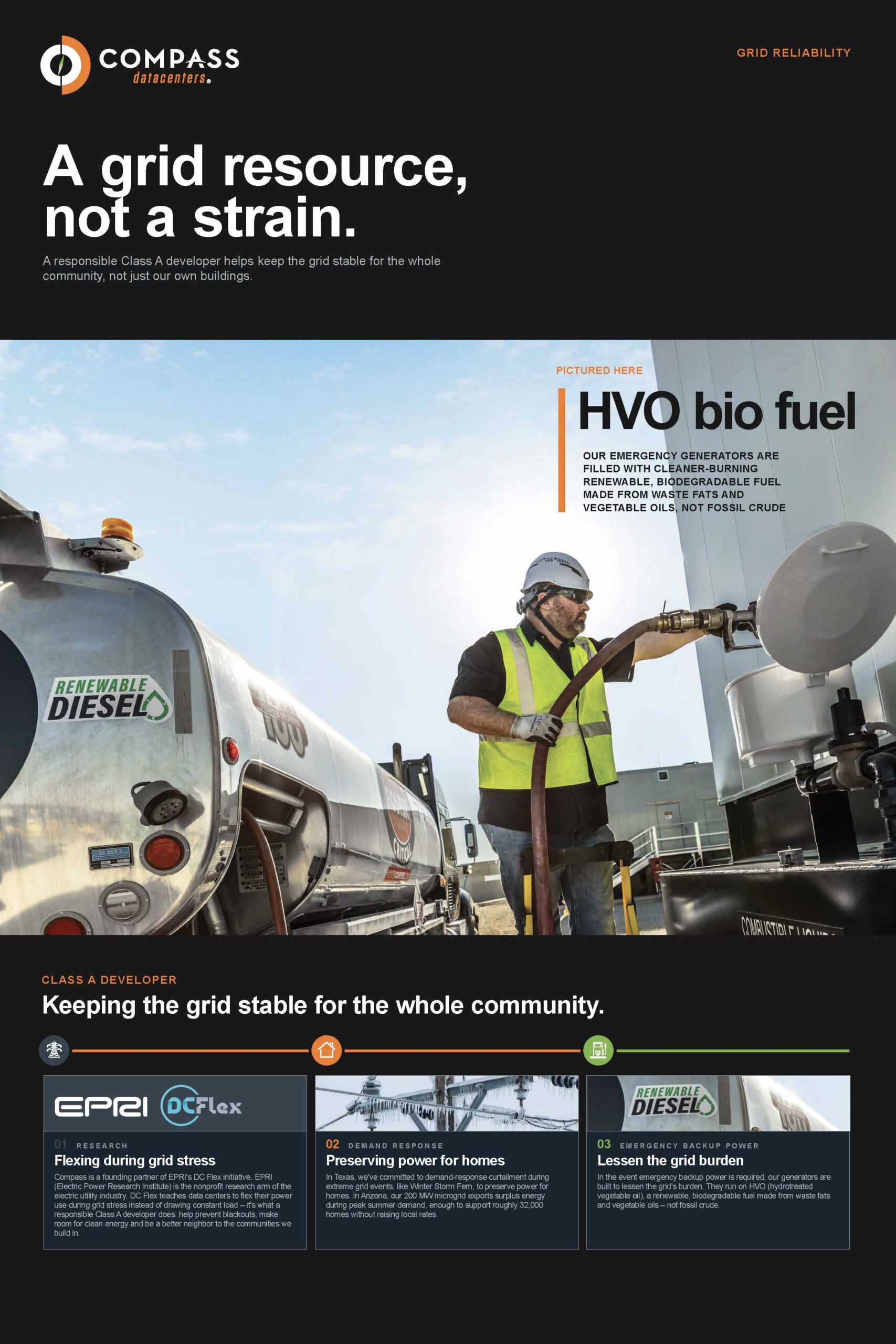
What about backup generators? Will we smell or hear them? Generators are there for one reason: to keep the site running if utility power fails. They are not a power source, and they do not run to supply the campus. Our generators run on cleaner-burning biofuel rather than traditional diesel. They are tested periodically, during daytime hours, and both the emissions and the sound were included in the air quality analysis and the acoustic modeling filed with the County to ensure compliance with all EPA and local guidelines. |
|
What batteries are used to store energy, and what is the fire plan? There is no large-scale battery storage system planned here. Smaller local batteries bridge the seconds between losing utility power and the generators starting. They sit in enclosed, code-compliant units with fire detection and suppression built in, and our fire response plans are coordinated with local fire officials. |
|
Is there a nuclear reactor involved? No. There is nothing nuclear associated with this project — not under the site, not near it, not planned. Two unrelated stories are being mixed. One is an experimental reactor project in Parsons, Kansas, more than a hundred miles away. The other is an early-stage agreement between TerraPower, Evergy and the State to look at a possible future reactor site somewhere in Kansas, with no location chosen. |
|
Does EMF from power lines, substations or data center equipment cause health problems? No. The World Health Organization reviewed tens of thousands of studies and found no evidence that low-level EMF from power lines, substations or electrical equipment harms human health. It is the same kind that has flowed safely through household wiring and neighborhood power grids for more than a century. |
|
What about CO2 emissions? We read that AI data centers harm bees. Routine operations run on grid electricity with no combustion on site, so the campus produces no direct emissions, and nothing heated is discharged into any stream, pond or aquifer. The bee study circulating online estimates effects from global electricity emissions. It is not about conditions near any data center. We take the underlying concern seriously, which is part of why the site’s 54.5 acres of floodplain will stay undeveloped.
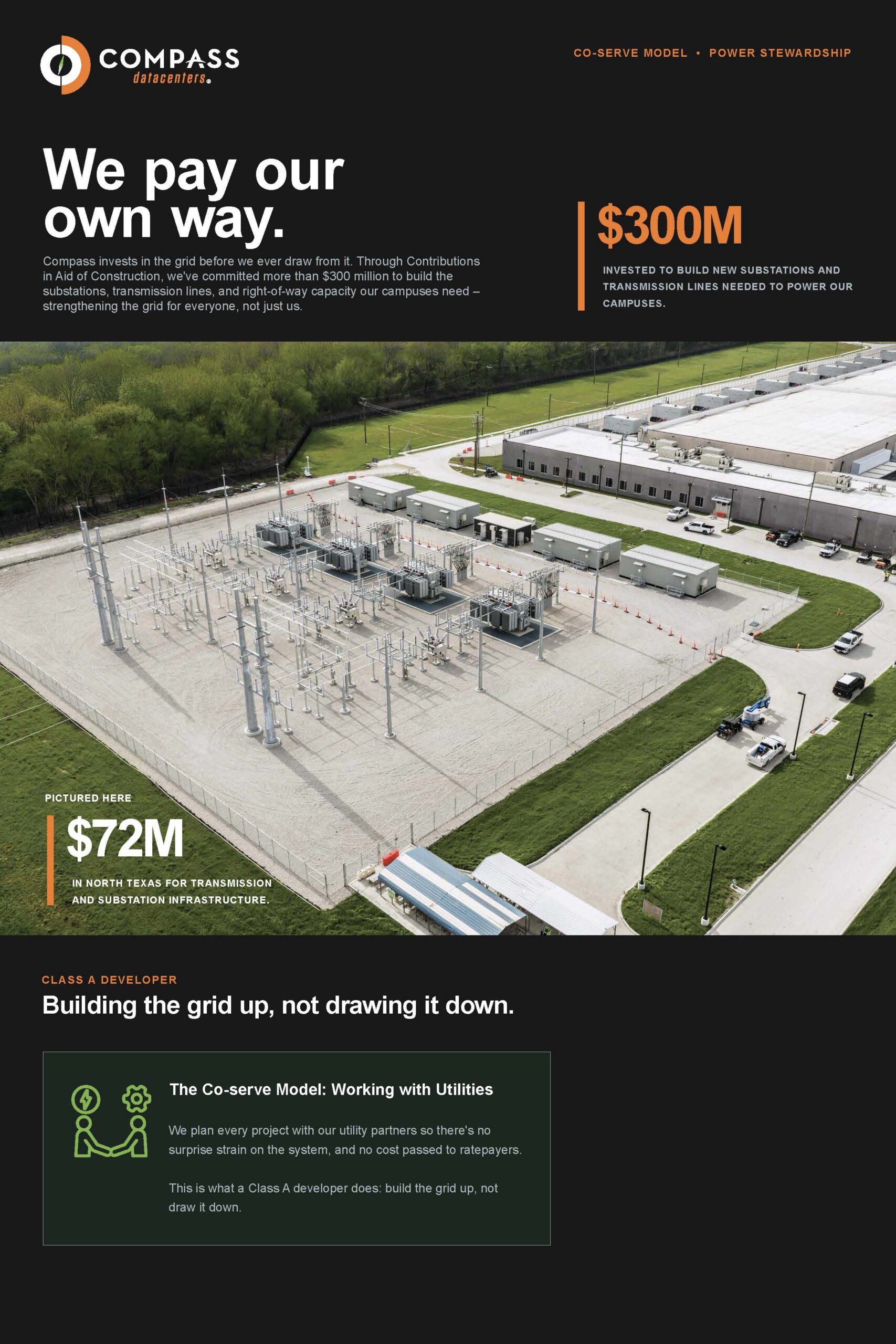
Is there enough grid capacity, and who pays to build more? In the short term, we would draw from the substation near the Walmart Distribution Center. Longer term, per our CUP submission, Compass will pay for a new substation and transmission that needs to be built. In Red Oak, Texas, we donated the land and purchased the transmission right-of-way for a new substation and switching station. Building at that scale unlocks capacity for others, providing the whole region with extra capacity.
What does it mean when you say you would power down? Compass power approach is community-first and grid-positive.There are two ways Compass works with utility partners to ensure homes are served first:
During Winter Storm Fern, Compass agreed to switch to backup generation to ensure local homes and businesses were powered first.
How much heat does the campus give off, and where does it go? Our modeling shows that at the property line the heat variance is practically imperceptible against normal outdoor conditions. Heat is rejected from our project the same way it is from the air conditioning equipment on any commercial building, except ours sits at ground level rather than on the roof. Inside our campuses, buildings are maintained at approximately 75°F. |
The Site and Neighbors
In the places you have already built, what effect has the campus had on land, water and air?
In the fifteen years we have been developing data centers, we have not seen a negative environmental effect on a site or the area around it. The studies we commission before filing help ensure that our design protects the community, the environment and our employees. Here’s an overview of our approach to conserving water.
Have your other campuses had environmental violations?
Five dates mentioned at the City Council working session come from incidents at our Leesburg campus, handled by the Virginia environmental agency. Together they are three notices of violation and the two consent orders that resolved them.
Here is what happened in each case.
- Generator operation in 2024. Two notices came that year. The first, on February 27, for running generators during an ozone-restricted period. The second, on May 7, was for an emissions exceedance caused by a setting programmed incorrectly at the factory. We reprogrammed the generators, and a single consent order issued January 21, 2025, resolved both notices, setting out the stack testing we completed and the penalty we paid.
- Major utility outage. In June 2025, an aging utility-owned substation feeding our site, which we had paid to replace, caught fire. This was before the utility completed our second, paid-for redundant connection (which was more than a year late from the utility). The fire was at the utility’s substation, not at our campus, and nothing at our facility caused it.With that redundant connection unavailable, our generators ran longer than the permit allowed as the utility made repairs. When complete, testing showed that our actual emissions stayed within permitted limits, although we exceeded the permitted hours. The agency agreed the permit should be tied to emissions, and that change was made. The notice of violation came on August 21, 2025 and the consent order resolving it on March 16, 2026. There was a small administrative fine for exceeding the time limit in the original permit.
In all cases we cooperated with the agency, fixed what caused the problem and paid what was owed.
In Arizona, a twice-yearly emissions compliance report was filed after its deadline with Maricopa County. The county allowed us to file on March 20, 2026. There was no exceedance, no enforcement action and no penalty.
Has a campus ever affected wildlife, farm animals or migratory birds?
We have never seen or received a filing indicating an impact on wildlife. That is an area we study before we build to be sure we design and build responsibly.
To protect Goose Creek at our Leesburg, Virginia campus, we established a 200-foot conservation buffer, improved stormwater treatment and supported watershed protection with a $60,000 donation to the Goose Creek Association used to restart its water quality monitoring program.
At our Goodyear, Arizona campus, the site was a working alfalfa farm drawing on high-capacity agricultural wells. Replacing that use with waterless cooling returned water to the local table. We also funded improvements to Bullard Wash at no cost to the community, and during monsoon rains the site slows and captures stormwater in retention ponds, filters it through native vegetation and releases it to the Salt River in a controlled way.
What happens in an emergency?
The campus runs around the clock and is monitored 24/7. Safety is a top priority, and we work continuously to identify and mitigate risk before it becomes a problem. Our CUP submission includes our emergency response plan which is coordinated with Topeka and Shawnee County officials. Due to the size of the client’s technology investment inside our buildings, we utilize the most advanced fire prevention and detection systems in the world.
Will the campus affect property values nearby?
We have not seen home values decline near our campuses. A recent Realtor.com analysis of ZIP codes that added a large data center found no meaningful effect on home prices in either direction. That report is linked here: Realtor.com
Taxes and Incentives
How much would the project pay in property taxes, and to whom?
Overall Estimate: Once all ten buildings are operating, first-year property taxes are estimated between $116 million and $165 million a year. That’s more than 20 times what Shawnee County’s two largest private taxpayers – Mars and Target – paid combined in 2025: $2.83 million and $2.22 million, for a total of $5.05 million. The range for Compass depends on two things:
- What the campus is judged to be worth. An appraisal based on what it costs to build is about $4.5 billion. An appraisal based on the value of its power capacity is about
$4.1 billion. - How much of it counts as taxable real property. Kansas taxes commercial real property at 25% of appraised value. Equipment classified as business personal property is treated differently, and Kansas law makes that call case by case rather than by a fixed rule.
Where the money would go: Based on an estimated project value of $4.5 billion:
- Up to $55 million a year to Shawnee County, roughly half of what the county collected from every property owner combined in 2023
- As much as $65 million to local schools
- Up to $45 million to other local jurisdictions, including the Wakarusa Watershed Joint District, the Topeka Regional Airport and local public libraries
If the City annexes the land: Up to an estimated $42 million a year would go to the City of Topeka.
In later years: The amount collected would follow the appraised value, which the County Appraiser sets.
Sources: FTI Consulting, Forvis Mazars, Shawnee County Appraiser’s Office, Top Assessed Values Report (2025)
Are you seeking tax breaks, or would you lobby for them later?
We aren’t seeking local exemptions or abatements for this project.
Kansas Senate Bill 98 exempts qualifying data centers from state and local sales tax for twenty years. It is available to any project that meets the threshold, and it does not apply to property taxes, which is the money described above.
What is the projected twenty-year value of the SB 98 exemption by phase?
About $38 million to $42 million per building, covering the campus build. The campus goes up in phases, so the value for Compass arrives as each building is constructed rather than all at once. The range reflects that Kansas does not tax construction labor on new commercial construction, so a portion of the project goes untaxed with or without SB 98.
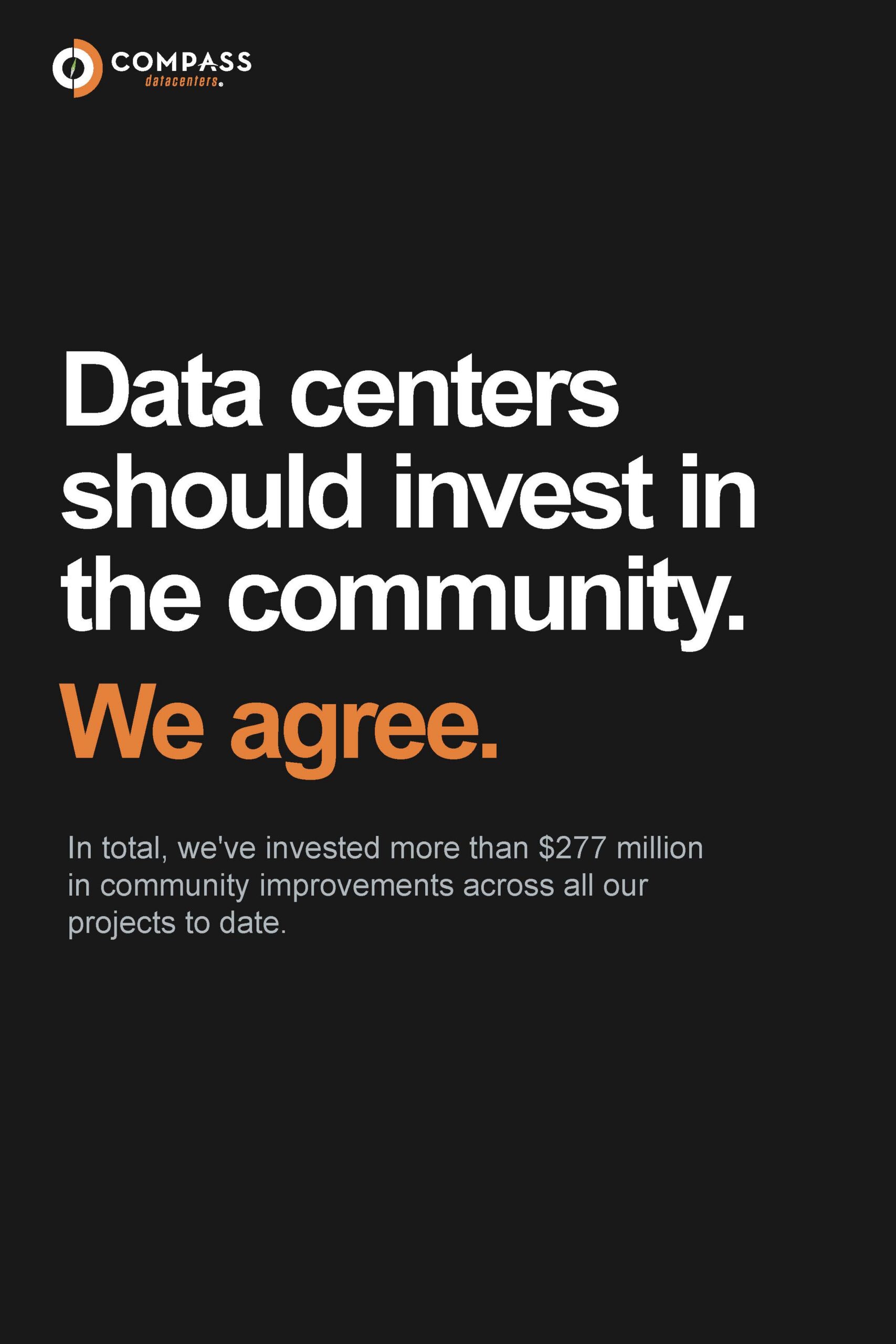
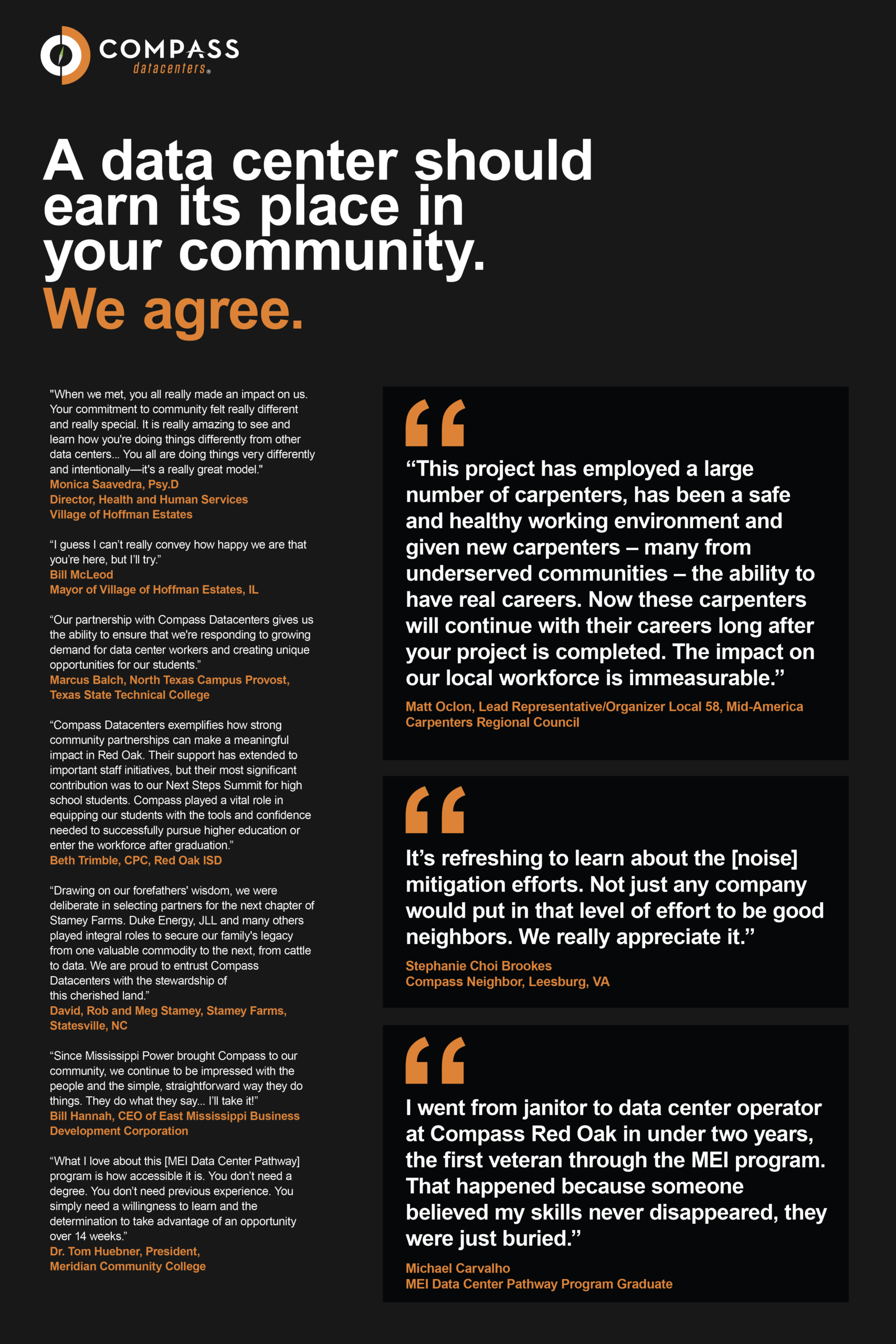
What a qualified developer receives is a one-time break on what it costs to build. What the community receives is recurring: tax base, payroll and local spending that arrive every year the campus operates and do not expire when the exemption is used up. Compass also makes long-lasting community investments that bring value for decades.
Sources: Compass tax counsel. Kansas Session Laws of 2025, Chapter 124
Would the project affect the franchise fees Evergy pays the City?
That is a question for Evergy. What we can speak to is that Compass pays for the substation and transmission required to power our campus, so those costs are not added to anyone’s bill.
Do property taxes actually go down in communities that host data centers?
That decision belongs to the taxing jurisdiction, not to us. Projects like this add significantly to the tax base, and some jurisdictions have chosen to use that to reduce residential property taxes. Communities including Quincy, Washington, Loudoun County, Virginia and Covington, Georgia (who will vote in November) are using data center revenues to cut property taxes. Red Oak, Texas, is expecting to reduce property taxes too.
Accountability
What legally enforceable commitments will you make on noise, water, rates, traffic and the environment, and what happens if you fail to meet them?
We have asked the County to write our water commitments into the permit as enforceable conditions, and we are willing to do the same on noise, lighting, traffic and construction hours. Our permit is enforceable by the County, and violations come with financial penalties.
Has any elected official or public employee signed a non-disclosure agreement with Compass?
No.
Where can the public find your materials?
Everything is posted at compassdatacenters.com/topeka: the display boards used at the July open house, the project overview video, and the answers to questions we have received to date. If something is missing, or there is a question you think we should add, please contact us at community@compassdatacenters.com and we will add it.